How Universal Capitalism Can Provide Economic Fairness: A Fireside Chat with Steven Hill
Description
In this video, Maureen Conway — a vice president of the Aspen Institute and executive director of the Institute’s Economic Opportunities Program — speaks with Steven Hill — a fellow with the Rutgers Institute for the Study of Employee Ownership and Profit Sharing and author of the book, “Expand Social Security Now.”
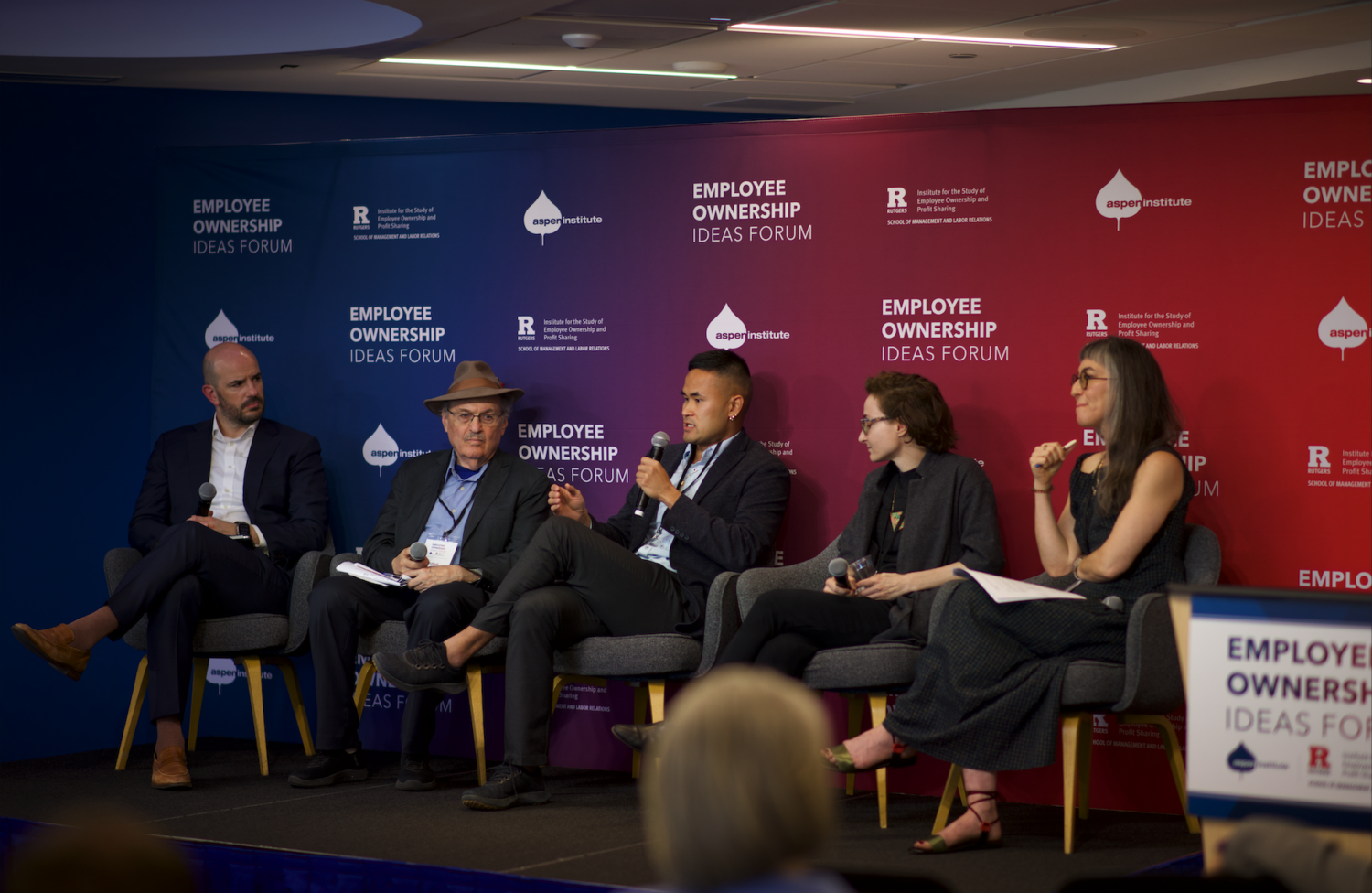
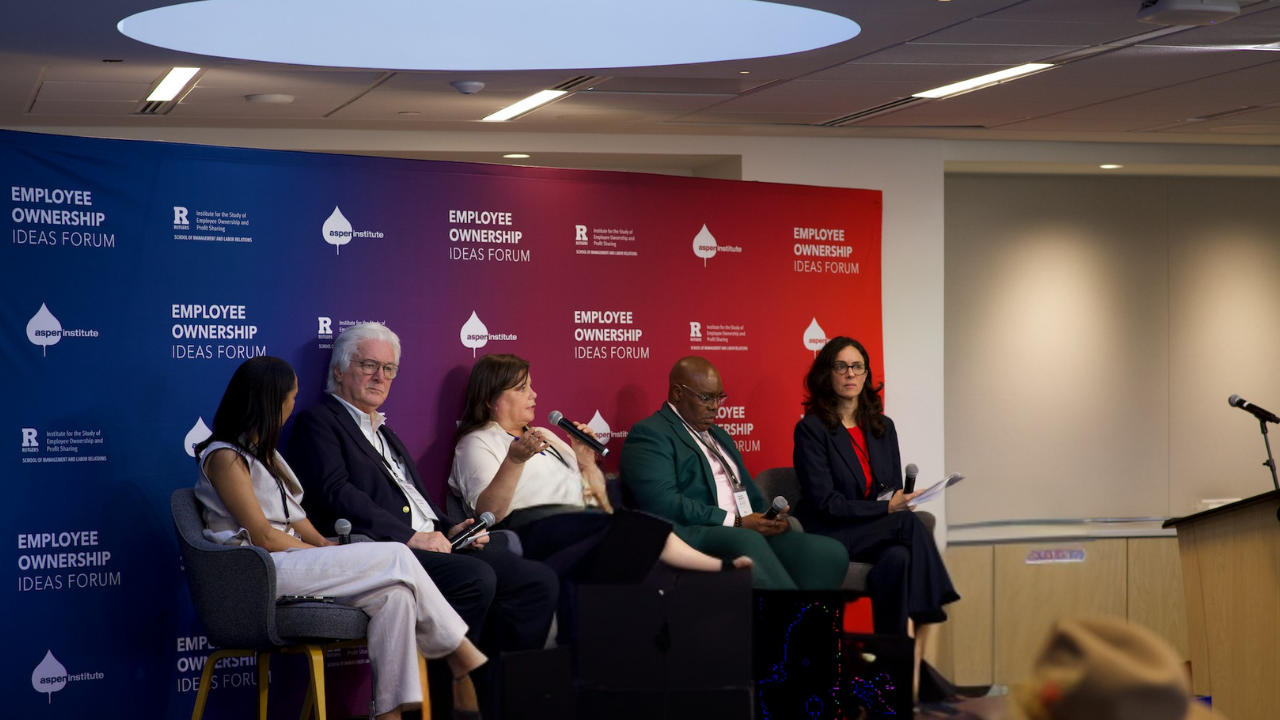
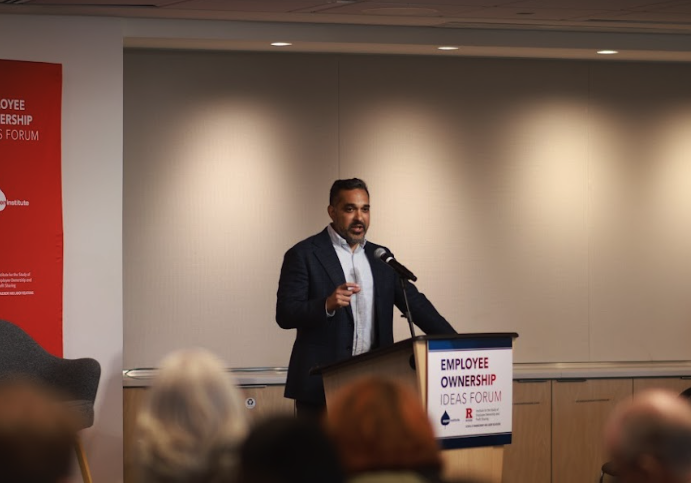
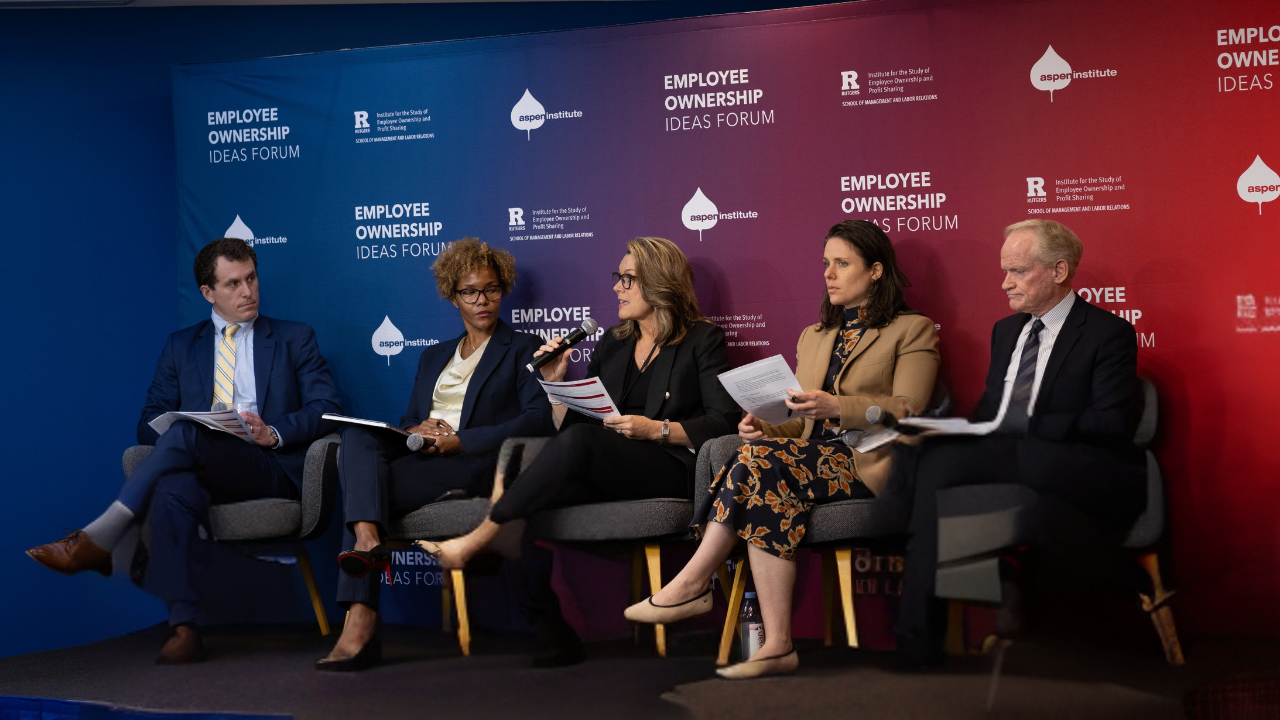
This video comes from the 2026 Employee Ownership Ideas Forum, which took place on June 2-3, 2026, in Washington DC and online.
For more videos from the Forum, visit our event page or subscribe to our YouTube channel.
And subscribe to our podcast to listen on the go.
Resources
- Book: Expand Social Security Now! How to Ensure Americans Get the Retirement They Deserve
- Article: Affordability Crisis and AI: Kelso’s Universal Capitalism
[00:00:05] Maureen Conway: This next session is How Universal Capitalism Can Provide Economic Fairness: A Fireside Chat with Steven Hill. I just want to say, going into this, I just recognize what a great room this is. I’ve had such a good time talking with those of you who I’ve had a minute to talk to. There’s so much expertise and wisdom in this room. I’m going to start and ask a few questions, but we are going to try to come to you sooner rather than later for questions. Be thinking about questions you want to ask because I’m really hoping to involve the room a little bit in this conversation.
It is my pleasure to introduce Steven. Steven Hill has spent decades asking hard questions about where the economy is headed and who gets left behind. His 2015 book Raw Deal on the rise of the gig economy and what it means for workers was an international bestseller and anticipated debates that are now central to economic policy conversations everywhere. He’s held senior positions at New America, Center for Humane Technology, and FairVote, and his writing has appeared in a variety of media outlets that you all know and I don’t need to list.
He is currently working on a biography of Louis Kelso, which is why we asked him to come talk with us today. He is also a fellow at the Rutgers Institute for the Study of Employee Ownership and Profit Sharing, which makes him a colleague to many of us in this room. Welcome, Steven. Really glad to have you here with us today.
[00:01:42] Steven Hill: Thank you, Maureen.
[00:01:45] Maureen Conway: Just to jump right in, for those in the audience who may not know much about him, can you say a little bit about who Louis Kelso was and what it was about Kelso, his ideas, his life, his relevance today that inspired you to want to write a book about him?
[00:02:02] Steven Hill: First, I’d like to ask, how many people here have heard of Louis Kelso? I’ll expose you. How many have not? A fair number who have not. Louis Kelso was the inventor of the employee stock ownership plan. Believe it or not, there was someone who invented this thing. The story of Louis Kelso is really the creation story of this movement. It didn’t happen overnight. It didn’t happen easily. It took a lot of hard work. Louis Kelso worked indefatigably for about 20 years to pass the– He was the co-author with another colleague who many of you here know, John Menke. They co-authored the first ESOP law that was passed in 1974.
Louis himself was a very interesting, very charismatic figure, the head of a movement, if you will. Small movement but ambitious movement to transform how Americans would receive their living, their livelihoods. Not just having a wage, but he had the vision that everybody should have a second income, as he called it, which would be based on investment income.
He was born in 1913 in Denver, Colorado, born poor. He grew up through the Depression, and the Depression really put a big imprint on him. He didn’t understand how could there be so much productive capacity and so many people without work, without income. That set his life course to figure out the answer to that question and to come up with solutions to that question.
In between, he ended up going to World War II. He’s sitting in Panama as an officer, far away from the action where the excitement was. He said, “What do I do?” While he was in Panama during World War II, he wrote a 1,000-page manuscript that diagnosed what was wrong with capitalism and what the solution was. Then he became an attorney, a corporate and financial attorney, moved to San Francisco, started a family.
In 1958, he published a book that became a bestseller. It was called The Capitalist Manifesto. Sound familiar? He saw himself as taking Karl Marx and turning him on his head. He said Karl Marx actually diagnosed capitalism pretty well. The problem was his solution was wrong. The solution isn’t to have the state owning everything, it’s to have more people owning everything and have more people having ownership in the most prosperous companies that were making money.
Kelso had basically two insights that he was trying to deal with and that he put into his work. One was how do we deal with this concentration of wealth, which in the late 1950s, 1960s, and ’70s was when he was really working on this, was becoming greater and greater already. The second was 60 years before Thomas Piketty wrote r > g, Kelso said, “We have a problem here with capitalism. The problem is that new technologies generates more and more wealth, but it mostly generates it for the people that own the technology and own the companies that have the technology. What about everybody else?”
He predicted that as this progresses through the 1960s, ’70s, and ’80s, what’s going to happen is that fewer and fewer people are going to own the wealth that is coming from the productivity increases that come from new technologies. Labor is going to be less important, labor unions are going to be less important, and wages are going to go down. He predicted this in the late 1950s in his book, Capitalist Manifesto. You look at where we are today, it’s like, “Louis got it right.”
He not only predicted this, but then he had solutions. The solution that he put forward in The Capitalist Manifesto was what he called universal capitalism. You can think of universal capitalism as the quiver. There are several arrows in this quiver of financial tools that would overcome these two trends that he identified. One of them was employee stock ownership plan. Then the other two arrows in the quiver, he had something called community stock ownership plan and general stock ownership plan.
If any of you have heard of the Alaska Permanent Fund, where every Alaskan gets $2,000 to $3,000 a year based on the oil revenue that comes into Alaska, that is a form of a Louis Kelso GSOP. We can talk more about that if that’s of interest, but be aware that ESOP is within a broader umbrella of universal capitalism. It became the most successful of the arrows in the quiver, and so it took off from there. CSOPs and GSOPs, which could be used by cities, by states, to–
If you’re a city that needs to create an affordable housing fund, you can use the same principles that are used now for ESOPs and for use for sovereign wealth funds to create that affordable housing fund without using any taxpayer money and to grow the money to pay for affordable housing. There’s a lot of things we could be doing with the universal capitalism philosophy that Louis Kelso came up with in the 1950s and ’60s and the ’70s.
[00:07:29] Maureen Conway: Great. You didn’t answer one part of my question, which was, how did you? Because you were writing about gig economy, and you’re writing about all kinds of other things. What drew you to Kelso?
[00:07:42] Steven Hill: I didn’t know very much about this at all, to be honest. I knew about employee stock ownership, but very little. I knew as much as the average person and maybe a little bit more. Just through meeting people like Patricia Kelso, who was Louis’s widow, who died last July 4th at the age of 98. She was still sharp as a tack at the end. I saw her a week before she passed. Just learning about it and realizing, “My goodness, if we’re going to really get a handle on inequality and we’re going to get a handle on how we’re going to broaden the wealth in this society so that–“
The other thing I should say that Kelso talked about, in fact, in an interview with Bill Moyers in 1990, he said, “This is not just about inequality, that if you don’t have a society with less inequality, you won’t have a political democracy anymore.” In Kelso’s mind, this was very much connected to political democracy itself. A lot of what he wrote about was why political democracy would only thrive if you had less inequality, you had more– It wasn’t just about welfare transfers. He was about ownership. More people needed to own what the economy is producing.
In fact, Kelso’s own politics, you could probably describe them as libertarian. He wasn’t into big government. He was almost a cold warrior back there in the ’60s and ’70s. It was either Soviets versus United States. He said, “This is the way we can beat the Soviet Union, by broadening ownership. The Soviets are trying to have the state own everything. We want to have the people owning everything.” He called it ownership for the millions, and that’s what he worked on for decades. His wife, Patricia, was a big part of that.
As I learned more, I learned about the story, the more I got attracted to it and started plunging into it, meeting people like Joseph Blasi and others from Rutgers and going to their conferences. John Menke is an incredible man. I just said, “This is a movement that I can maybe help with in my humble way.”
[00:09:54] Maureen Conway: Great. Thank you. I love that vision of him writing 1,000 pages in Panama because he’s got nothing else to do. Anyway, but I did want to say, also, and we talked about this before, his ideas about the importance of one ownership and how ownership is important to a democratic society. We talked about how they are connected to a broader American tradition. I was just wondering if you could say a little bit more about how that idea connects to some of those founding father traditions and other things and ways we’ve seen it. Also, maybe a little bit about where that fell out of our history.
[00:10:34] Steven Hill: Yes, absolutely. Louis Kelso very much saw himself in a long American tradition that went back to the founders. In fact, Joseph and Doug Kruse, I don’t know if Doug is still here, they wrote a book called Citizen’s Share, which they trace this tradition all the way back to the founders. The founders believed, Thomas Jefferson with his yeoman farmer philosophy, that the ownership of property was essential to political democracy.
You carry that viewpoint forward, Abraham Lincoln with his Homestead Act. It was the first government action, as far as I’ve been able to find, in which the government officially said, “Property ownership is important to the American dream, to our identity, our culture, to political democracy.” The populist farmers of the 1890s were also trying to act on this belief.
Somehow, we lost that thread right around that time, 1890s into the 1900s, where suddenly the ownership of property as it shifted, not from land anymore, but it shifted to stocks and bonds and all these other types of property. Suddenly, and today’s part of our property is our data, we lost the thread where property ownership is important to the American dream, it is important to political culture, it is important to democracy.
In some ways, what we’re trying to do today, what we’ve been talking about today, is reclaiming this American tradition that has been there since the very beginning and making it clear that now that wealth has turned into a different form of wealth than land, we still have an important urgent need that many, many Americans have ownership of that type of wealth that’s out there today if we’re going to keep our political democracy.
[00:12:30] Maureen Conway: Great. Thank you. I just want to dig in a little bit on this technology, productivity, broad-based prosperity kind of thing. If you could say a little bit more about what his view was about technological progress and broad-based prosperity. I mentioned in my opening remarks this morning, those two things, technological progress and broad-based prosperity, do not always go together in history. What was his thought about that, and what it takes to make that happen?
I’m just wondering also if you want to comment on where we are today with artificial intelligence, with intellectual property. Property, as you’re saying, isn’t as tangible as it used to be. What do you think he would see as both opportunities for broad-based ownership? Also, what do you think he would see as risks?
[00:13:24] Steven Hill: Louis Kelso was very pro-technology. He believed that technology was important, that increasing labor productivity was important. That’s why he said it’s really important that the ownership of that technology and the companies that are using that technology must be broad and diverse, because the natural outgrowth of new technologies is you need fewer workers.
Sure, you can say, “We’ve always found new jobs for people.” That’s the comeback to that. Besides the quantity of jobs, there’s something about the quality of jobs. What are the quality of jobs going to be? If the human is just hitting the button to start the process, and then the robots and the software and everything else is doing everything else, those jobs are not going to pay very well.
Kelso, he looked back through history, and he saw the progression of technology and where it was going, and he said, “We can see where this is going to go 50 years from now. This is not going to end well.” That’s where he said the only solution is that more and more people need to be the owners of the technology. That’s where something like an ESOP. Now you have the employees who are owners of the company. If the company is using technologies, they’re getting a share of the profits that come from that.
You have something like Norway’s sovereign wealth fund. If you’re familiar, that’s basically a Kelso type of GSOP, where, if you’re not familiar with it, Norway has a lot of oil. They take the oil and the revenue from that oil, and they take it and they put it into a fund. They take that money, and they invest it in the stock market. Then they leave it there, and they let it grow. That sovereign wealth fund in Norway now has $2 trillion. In fact, it contributes more to the Norway budget than the oil revenue does.
When you leave it in there, when you benefit from the years of interest and compound interest and these sorts of things– Keep in mind, Kelso, he was a financial genius. He was a lawyer, but he was a corporate and financial lawyer, so he understood how markets worked. He understood what happens if you take some money and you leave it there and let it grow. It will grow, and then you can use it for other things.
I think right now, he’d say there’s an opportunity with AI, but the political part of that that has to complement the economic part is just really, really not doing well. There’s got to be a way to harness the capitalist engine, which is the greatest wealth generator that humans have ever devised, but who gets the wealth?
It’s not so much that there’s these nefarious people out there that are just trying to keep the money all for themselves. There are some of those, okay. It’s more, as Kelso would say, it’s how the system works. It’s how the system works. If you’re going to change that, you have to change how the system works. His idea was ESOPs, CSOPs, sovereign wealth funds. I’ll stop there. I can tell more about CSOPs and GSOPs, which could have an amazing application as well, if we have time.
[00:16:43] Maureen Conway: That’s what I was going to ask you next, and then I’m going to see what questions other folks have. I thought it was interesting when we talked, you mentioned the number of states that have these kinds of funds, which I didn’t realize how many did. I think we talked about how he saw that ESOPs are great, but that’s not going to reach the numbers that you want to reach to make sure everybody has an ownership stake. Maybe you could just say a little bit more about his vision for those kinds of structures and where we see them today in the United States.
[00:17:20] Steven Hill: Sure. As we’ve been hearing, there’s 15 million workers covered by ESOPs today, and that’s a lot. That’s more than there are labor union members. Yet there’s another 130 million workers that are not covered. What do you do about those other 130 million workers? One, we keep trying to figure out ways to expand ESOPs. That’s crucial to what we have to do. Two, there are other ways to harness the market so that more people can be owners to the investment returns that come from these companies.
There are 20 states in the United States that have, they’re called sovereign wealth funds. I call them social wealth funds at the state level. These are states like New Mexico, one of the poorest states in the union. They discovered a bunch of oil. What do you do with that oil? Do you just spend it on doing good things? Yes, you do some of that, but they took some and they put it in a fund, and they’re letting it grow. As it grows, they have more money than they would have had if they had just spent all the oil money.
They’re putting a lot of that money into education. Every New Mexico student who goes to college now gets a free college education if they go to a New Mexico school. It’s being paid for by the Sovereign Wealth Fund of New Mexico. Alaska has the Permanent Fund. It’s basically a sovereign wealth fund. Other states have a similar type of fund. A lot of them are funded by oil. With any kind of fund like this, there’s always a question of what’s your seed money? If you have oil, that’s the best of all, really, or any kind of natural resource money, if you don’t have to pay off a loan as your seed money to investors, and you have more money at the end of the growth period.
These states are already doing it, some of them doing it better than others. Saudi Arabia has a famous sovereign wealth fund. It’s a good example of spending a sovereign wealth fund badly. They put $6 billion into a professional golf league that is now going bankrupt. You could do bad things with these kinds of funds, too. On principle, these funds have the opportunity to raise a lot of money.
The thing to understand is that you’re doing it all without taxpayer money. The benefits that are coming to the beneficiaries from an ESOP is not from taxes. It’s not from them putting money into it. It’s because you’re getting the seed money, you’re investing it. In an ESOP, you’re doing it into the company’s stock. The employees are getting a share of it, and then they get the future returns that come from leaving it and letting it grow. You’re not using taxpayer money. You’re not using the person’s own resources.
The idea of having a 401(k) and an IRA, it’s great, except that what we learn is most people don’t have enough money to put in them. If you do have some, you’re not going to risk it in the stock market. What Kelso realized was we’ve got to create a way that takes away the risk from average people to invest in the markets so that it’s time for it to grow over the ups and downs of the market, and then at the end of that period of time, they get the benefit of that fund. That’s really what Kelso was trying to do. In some ways, it’s a very simple thing, but it hadn’t been done before, and of course, the politics always makes everything complicated.
[00:20:40] Maureen Conway: Great. I’d like to invite Paula.
[00:20:43] Paula: Thank you. I had a question more around CSOPs.
[00:20:48] Maureen Conway: Can people hear her, or should I give her a mic?
[00:20:50] Audience Member 1: Give her a mic.
[00:20:51] Maureen Conway: Okay.
[00:20:54] Paula: I had a question, more so around AI and CSOPs. What potential applications do you see really for the infrastructure build-out around AI and the energy infrastructure, the data center infrastructure, and those types of things?
[00:21:17] Steven Hill: In some ways, it’s two questions because the thing around data centers is so controversial, what it’s doing to communities, and communities are fighting it. I don’t want to wade into that discussion. Certainly, if you look at the stock market today, it’s basically eight companies that are doing all the growth in the stock market. If you even just harness the wealth of those companies– In fact, Sam Altman from OpenAI has proposed that these companies that are above a certain amount should give a certain amount of their stock into the fund that would then grow, and at a certain amount of time, you then could sell that stock and you’d have a lot of money, a pot of money to pay for public goods and services.
Some of the tech leaders are thinking along these lines. Some people think, “They’re just trying to cover their butts because everyone’s worried that everyone’s going to lose their jobs, and so this is their solution.” Still, conceptually, it’s a good idea to basically try to harness that capitalist engine, which is so focused in tech right now, Silicon Valley and around Microsoft and Amazon in Seattle, that it seems like if they are willing to try something, why not take them up on it? The data centers, I’m not going to go into that because I understand for a lot of communities, they may not want them where they live.
[00:22:48] Audience Member 2: Thank you. I don’t know where you are in the research of your book, but have you had a chance to talk to Jens Lowitzsch, who’s the Kelso Institute Europe head, who knew Patricia quite well, and he gives papers all the time on CSOPs all over the globe?
[00:23:06] Steven Hill: Yes, Jens and I are close. In fact, the answer to Maureen’s earlier question, Jens is the one who introduced me to all of this. It’s his fault.
[laughter]
[00:23:15] Audience Member 1: Never mind.
[00:23:16] Steven Hill: Yes, yes. I was on a fellowship in Berlin, and that’s where I met Jens through a friend of a friend, and then one thing led to another, and here we are. Jens is working a lot on CSOPs. For example, in California, we’re having a lot of problems with our public utility, Pacific Gas and Electric, and it’s a long story. One option that could have been explored there was to use a CSOP for the ratepayers to buy PG&E, and then the ratepayers would own it, and it wouldn’t cost the ratepayers anything to do it.
You set up the trust, you get a loan to pay for the buyout, and then you pay for the loan out of the future returns on your new investment. This is what wealthy people, wealthy companies have been doing for decades. In some ways, there’s been a gold rush going on for the last 70 years, and the only ones that have benefited from it are the upper 10%. 10% of Americans own 93% of the stock. They’re the only ones that have benefited from this decades-long gold rush.
What Kelso was about was figuring out a way to let other people benefit from this gold rush. You could do it through CSOPs, where you create public power essentially by using public power. You don’t have to pay a dividend anymore to investors. You actually get a federal tax write-off if you’re a public power company, and you can pass those costs on to ratepayers or do other things with that money. There’s lots of things you could do with CSOPs.
I’ll give you another example of CSOP that Louis Kelso did. There was a co-op of 5,000 farmers in the Central Valley of California. They were getting hammered by the oil companies who controlled the fertilizer industry. They had a monopoly. They were gouging them on prices. Kelso got a bank loan for this co-op. They set up a trust. The trust oversees the bank loan. They created their own fertilizer factory, and then they paid for the loan that created the fertilizer factory out of the future returns on the fertilizer factory.
Not only did they pay it off in half the time that the loan was supposed to mature in, but they were able to cut the price of fertilizer in half. This is another example of how you can use these kind of social wealth fund principles that Kelso first created to do a lot of amazing things. Cities can be doing this for a housing fund, for a transportation fund, for daycare fund. You could have multiple funds. A state could be doing this. There’s all sorts of things you could take– Once you have the money, you can direct it to any of the public goods and services that you need in your city or state or nation to pay for things. Social Security could be shored up this way. Other things that we are trying to do.
[00:26:10] Maureen Conway: Great. Yes?
[00:26:15] Audience Member 3: [inaudible 00:26:15]
[laughter]
[00:26:20] Audience Member 3: In the course of doing your research, did you stumble on anything that could help explain, out of the three different pillars you note for universal capitalism, why ESOPs are so much more well-known or popular versus these CSOPs? Because it sounds like early on, there were working examples. If it’s something to do with policy, do you see what could help maybe encourage or incentivize more CSOPs?
[00:26:50] Steven Hill: That’s a good question. Louis Kelso, he was an amazing figure. He was like someone you’d say had no reverse gear. If you were sitting next to him on an airplane, he’d be talking to you about, maybe not ESOPs, but he’d say, “Do you own anything? Do you just have wages? You have to have a piece of the rock.”
One of his secretaries, he pulled her aside one time, he said, “It’s really time for you to buy something, some piece of property.” She said, “Like what?” He said, “How about like an apartment building? You need to have an apartment building.” He helped her purchase an apartment building, four units, that she still has today, and that allowed her to leave work, working for a wage at a job, and just run her apartment building for her income.
There’s other stories. Kelso, he would give a lecture in a grand hotel ballroom, and in the audience would be bankers and CEOs and politicians. Then afterwards, they say, “Where’s Louis?” He’s in the kitchen talking to the kitchen help about why they need to buy property. They need to get a piece of the rock. This is just where he was coming from. He went along like this after The Capitalist Manifesto for 10, 15 years. He appeared on– Some of you saw Pete Stavros on 60 Minutes. Louis Kelso was on 60 Minutes with Mike Wallace in 1972, I think it was.
After knocking on a million doors, finally he went national. That led to a meeting with Senator Russell Long, Democrat from Louisiana. He was the head of the Senate Finance Committee, so in some ways the most powerful senator in Washington, DC. He loved this idea. He said, “My daddy was Huey Long,” populist. He said, “I’m not going to go the way he did. That didn’t end well. I like what you’re doing, and I like this employee ownership thing.” They already had a bill going through, what became ERISA.
The idea was, “Let’s include this in the ERISA law.” They had this famous meeting in the Madison Hotel here in Washington, DC. After a four-hour meeting with Louis, in which Louis talked his ear off and convinced him, he said, “I need legislation tomorrow.” That’s what led to it. After a decade and a half of knocking on doors, finally, Louis had traction with someone who had power and would listen, and from there, ESOPs took off.
The Kelso operation was not a big operation. They didn’t have the bandwidth. Today, if you look at NGOs like Sierra Club or whatever your favorite NGO is, they’ve got a communications director, they’ve got a deputy director, they’ve got all these staff that are doing all these things. It was basically Louis, his wife Patricia, and a few other lawyers. Some of the lawyers actually couldn’t stand Louis’s mission and eventually threw him out of his own firm. There’s a lot of stuff going on.
Once ESOPs took off, that took up a lot of time, and they didn’t have time for CSOPs and GSOPs. Later, Louis and Patricia co-authored a book in which they tried to bring CSOPs and GSOPs back into it with another book. The book sold well, but it wasn’t a bestseller. Long story short, Louis was getting older at that point and didn’t have the stamina to keep flying cross-country from San Francisco to Washington, DC. ESOPs is a great arrow in the quiver, but there’s other arrows in the quiver that really could do a lot depending on your situation, your city, your state, what have you, that I’m hoping that through the book, we can raise the profile of those others a little bit more.
[00:30:44] Maureen Conway: Great. Join me in thanking Steven for the-
[00:30:46] Steven Hill: Thank you.
[00:30:47] Maureen Conway: -interesting conversation.
[applause]
[00:30:52] Maureen Conway: I think we learn a lot from history, so we’ll get to reflect on it more when we get to see the whole book.
About the Employee Ownership Ideas Forum
The Employee Ownership Ideas Forum brings together leading policymakers, practitioners, experts, and the media for a robust discussion on how we can grow employee ownership for the shared benefit of American workers and businesses. It is hosted by the Aspen Institute Economic Opportunities Program and Rutgers Institute for the Study of Employee Ownership and Profit Sharing.
About the Rutgers Institute for the Study of Employee Ownership and Profit Sharing
The purpose of the Institute for the Study of Employee Ownership and Profit Sharing is to study the various models that have emerged and will emerge of employee ownership shares and profit shares in the corporation and society of the United States and around the world.
About the Economic Opportunities Program
The Aspen Institute Economic Opportunities Program advances strategies, policies, and ideas to help low- and moderate-income people thrive in a changing economy.
Join Our Mailing List
To receive occasional emails about our work — including new publications, commentary, events, fellowships, and more — join our mailing list.
Connect on Social Media
For news and updates every day, connect with us on the social media platform of your choice.