Not Found
We’re sorry. The content you are trying to access could not be located.
It may have been moved or deleted. Please email us at [email protected] for assistance, or view more from the Economic Opportunities Program on our website.
About the Economic Opportunities Program
The Aspen Institute Economic Opportunities Program advances strategies, policies, and ideas to help low- and moderate-income people thrive in a changing economy.
Join Our Mailing List
To receive occasional emails about our work — including new publications, commentary, events, fellowships, and more — join our mailing list.
Connect on Social Media
For news and updates every day, connect with us on the social media platform of your choice.
Videos
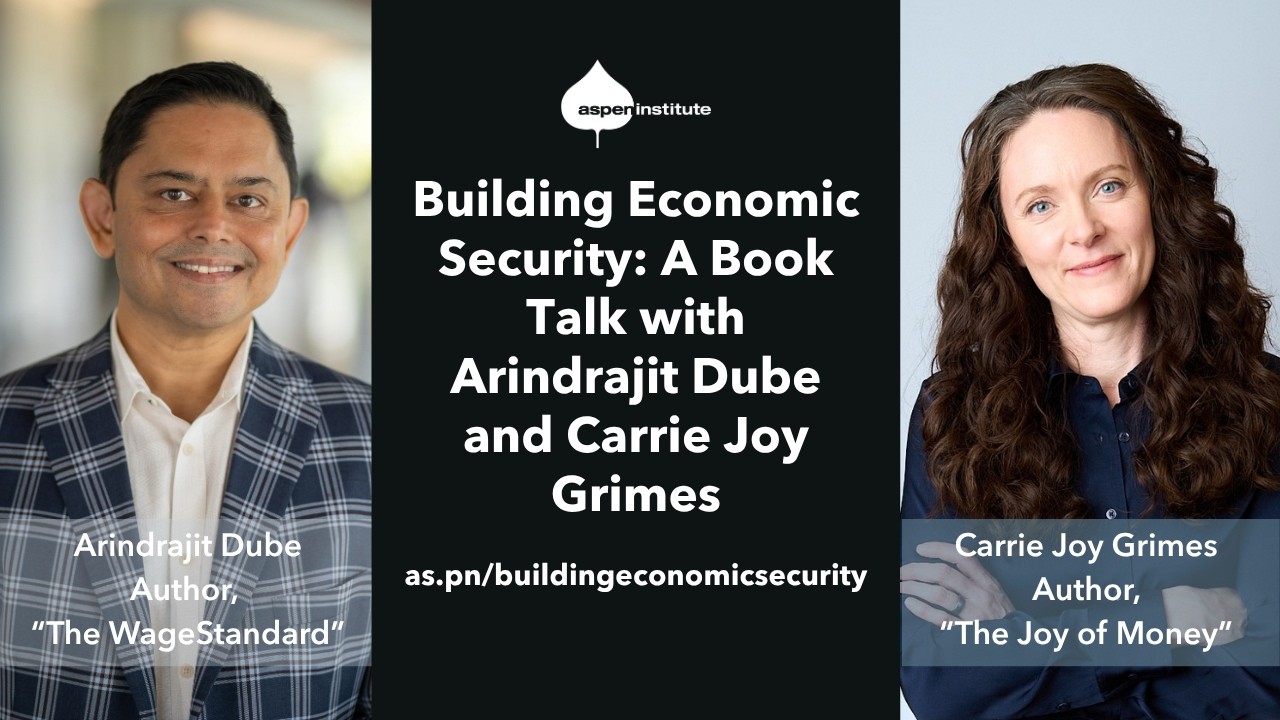
Building Economic Security: A Book Talk with Arindrajit Dube and Carrie Joy Grimes
Economic security shouldn’t be a lottery. Yet for millions of working families, stagnant wages and precarious jobs collide with the daily grind of managing money on shaky ground — leaving stability feeling less like a plan and more like a gamble. Fixing that takes more than one lever. It takes structural reform and the tools people need to take control of their financial lives, working together.

What Employee Ownership Means to Workers
Firms differ in how equity or profit is allocated, how long the ownership structure is intended to last, and how workers participate in governance and the workplace, all of which affect how workers experience ownership.

Employer-Friendly Practices: A Guide for Higher Education
This resource is designed to help colleges and universities become more employer-friendly and build the kind of institutional capacity that sustains and grows partnerships while simultaneously better serving working learners. It offers role-specific guidance for leaders across the institution, a self-assessment spanning five domains of practice, and a process for turning results into action, grounded in the conviction that institution/employer partnerships can become easier without compromising academic missions.

MillerKnoll: Developing Operations Leaders from Within and Beyond — A Case Study in Structured Talent Development
Bridge, Propel, and Career Academy are built on a practical philosophy: that MillerKnoll has great talent already inside the organization. Finding that talent, developing it, and aligning it to the right opportunities is key to its success. T

A Typology of State-Supported Work-Connected Learning Programs
States invest in work-connected learning through dozens of distinct funding streams, grant programs, and agency initiatives, often developed independently over time by different administrations and agencies pursuing different goals.