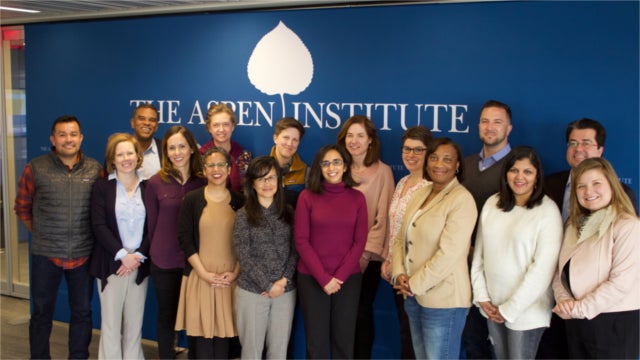
Aspen is a place for leaders to lift their sights above the possessions which possess them. To confront their own nature as human beings, to regain control over their own humanity by becoming more self-aware, more self-correcting, and hence more self-fulfilling.
The Economic Opportunity Fellows Network is a network of leadership and fellowship programs run by the Economic Opportunities Program.
Within this Network, EOP connects national and local leaders from across sectors — nonprofit, government, business, philanthropy, academia, and more — to advance policies and practices with the potential to help low- and moderate-income Americans thrive in today’s economy.
The Microfinance Impact Collaborative works to strengthen and accelerate the efforts of US microenterprise finance organizations committed to significantly increasing the scale and impact of their work.
About the Economic Opportunities Program
The Aspen Institute Economic Opportunities Program advances strategies, policies, and ideas to help low- and moderate-income people thrive in a changing economy.
Join Our Mailing List
To receive occasional emails about our work — including new publications, commentary, events, fellowships, and more — join our mailing list.
This publication examines how fragmented skills, credentialing, and workforce data systems limit the potential of skills-based hiring and advancement, and outlines a shared vision for building the interoperable infrastructure needed to create a connected skills ecosystem that benefits workers, employers, educators, and governments.
Economic security shouldn’t be a lottery. Yet for millions of working families, stagnant wages and precarious jobs collide with the daily grind of managing money on shaky ground — leaving stability feeling less like a plan and more like a gamble. Fixing that takes more than one lever. It takes structural reform and the tools people need to take control of their financial lives, working together.
This resource is designed to help colleges and universities become more employer-friendly and build the kind of institutional capacity that sustains and grows partnerships while simultaneously better serving working learners. It offers role-specific guidance for leaders across the institution, a self-assessment spanning five domains of practice, and a process for turning results into action, grounded in the conviction that institution/employer partnerships can become easier without compromising academic missions.